I've not been well lately! My self-diagnosis leaves me in no doubt that that I have a bad case of cabin-fever. This as a result of not getting out into the wilds for about a month now. I've had to console myself with browsing through my old camera-trap images. However, while doing this I decided that I needed to pull together a post about birds - specifically those that have walked in front of my cameras.
We're extremely fortunate to have a wide variety of large raptors, as well as terrestrial species, that are quite big enough to trigger a camera at some distance. So while I've only once actually set out to get images of birds (African penguins) I do get other big fellows fairly frequently. These are some of my favourites:
Secretary Bird (Sagittarius serpentarius) at a spot where I was hoping to get an image of a leopard recently seen in the area.
Lappet-faced Vulture (Torgos tracheliotus) bullying the other birds at the water-hole.
An African Hawk-Eagle (Hieraaetus spilogaster). What was amazing about this series of images was that the other mammals in the images waited in the background for it to finish (about 20 minutes) before drinking themselves.
Marabou Stork (Leptoptilos crumeniferus)
Kori Bustard (Ardeotis kori) - apparently the worlds heaviest flying bird.
A male Ostrich (Struthio camelus) with his young.
Hadeda Ibis (Bostrychia hagedash) an extremely successful species whose range is expanding dramatically in Southern Africa.
Black-headed Heron (Ardea melanocephala).
However I can feel the fever starting to subside already since I'm headed off next week to a remarkable place called the Tankwa Karoo National Park. Its renowned for its natural beauty, rather than abundance of mammals, but I'm hopeful that the cameras will pick up something interesting.
I'll keep you posted.........
What is BushCam Adventures?
BushCam Adventures attempts to share some of the amazing images, stories and insights that I've collected during my camera-trapping adventures.
Sunday, 21 October 2012
Monday, 8 October 2012
Lovely Legs
When setting up a trailcam I usually attempt to position it about 18" off the ground. I do this for a couple of reasons:
- it usually means that you don't miss the little guys, like a mongoose, that pass close by to the camera
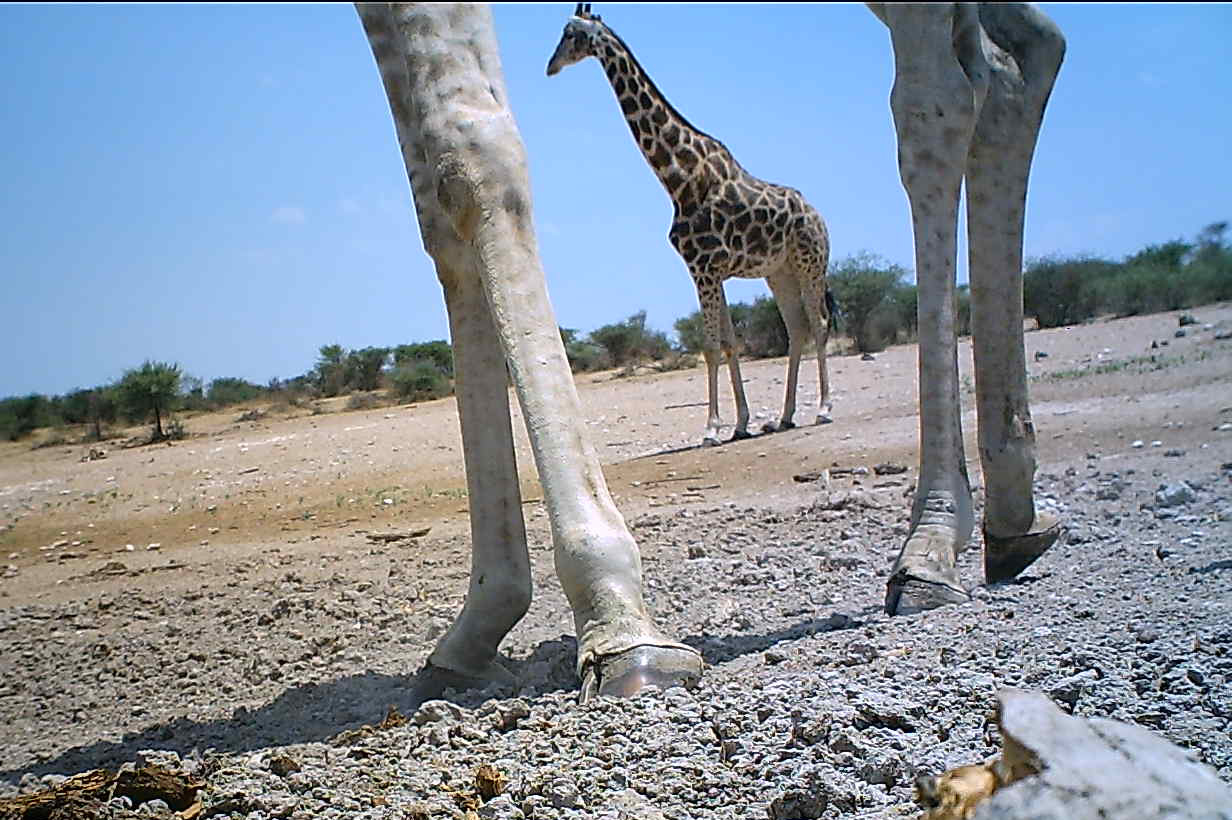
- a lot of wildlife photography (especially that of mammals) shows the subject level with, or slightly below, the photographer. I've got bored with this slightly 'superior' feel to wildlife photographs and so now prefer the quirky images that I get from the low angles.
What it does mean though is that I get a lot of leg shots when large mammals walk too close to the camera. Ideally, you might say, I should position the camera further away from the likely path that an animal might take. That's absolutely true but one doesn't always have too many options.
Notwithstanding the benefits of a well-framed photograph I always enjoy my leg shots. I think they often give a better 'sense of place' than would a photo of, say, an antelope's rump.
- it usually means that you don't miss the little guys, like a mongoose, that pass close by to the camera
- a lot of wildlife photography (especially that of mammals) shows the subject level with, or slightly below, the photographer. I've got bored with this slightly 'superior' feel to wildlife photographs and so now prefer the quirky images that I get from the low angles.
What it does mean though is that I get a lot of leg shots when large mammals walk too close to the camera. Ideally, you might say, I should position the camera further away from the likely path that an animal might take. That's absolutely true but one doesn't always have too many options.
Notwithstanding the benefits of a well-framed photograph I always enjoy my leg shots. I think they often give a better 'sense of place' than would a photo of, say, an antelope's rump.
Monday, 24 September 2012
Camera-trapping Workshop
I recently ran a camera-trapping workshop in the Waterberg region of South Africa. The wildlife reserve I used had a good variety of mammals but no lions, elephants or buffalo. So it was safe to walk around and set up our cameras as long as we kept a look out for the resident rhinos and hippos.
The management of the reserve had pointed out the carcasses of a wildebeest and a couple of impala that had been struck by lightning - which seemed like a good place to start. We also chose a couple of water-holes, rhino middens and interesting looking spots in some riverine vegetation. But we had less than 48 hours to get some good images so luck did need to be on our side.
Our first evening was very windy and cold which is seldom good for camera trapping. The results from the cameras confirmed this and the results were disappointing. However the following night was way better so we were cautiously optimistic that we might have bagged something interesting. This is what we got:
An African Hawk-Eagle (Aquila spilogaster) on a piece of the carcass. I've always known them as competent hunters so was surprised to see them scavenging a carcass.
But I wasn't surprised to see these two around the carcass:
A Brown Hyaena (Parahyaena brunnea) who enjoys nothing more than some ripe wildebeest and an African Civet (Civettictis civetta) who didn't hang around too long.
An then we were fortunate to get:
A Caracal (Caracal caracal) who seemed to find the camera's flash a bit much........
......an Eland (Tragelaphus oryx) who wandered past on one of the few occasions when the sun shone.....
....and a Waterbuck (Kobus ellipsiprymnus) with its characteristic 'toilet-seat' marking on its rear end.
I'd also spent the night before the workshop on the reserve and had picked up this Large Spotted Genet (I'm not sure if it is Genetta maculata or Genetta tigrina )
We also got unexciting images of giraffe, warthog, kudu, impala, zebra, jackal, wildebeest, bushbuck, baboon and vervet monkey. So I guess that wasn't bad for a weekend of 'trapping'.
Thanks to the management of Jembisa as well as my 'students'. I had a lot of fun!
The management of the reserve had pointed out the carcasses of a wildebeest and a couple of impala that had been struck by lightning - which seemed like a good place to start. We also chose a couple of water-holes, rhino middens and interesting looking spots in some riverine vegetation. But we had less than 48 hours to get some good images so luck did need to be on our side.
Our first evening was very windy and cold which is seldom good for camera trapping. The results from the cameras confirmed this and the results were disappointing. However the following night was way better so we were cautiously optimistic that we might have bagged something interesting. This is what we got:
An African Hawk-Eagle (Aquila spilogaster) on a piece of the carcass. I've always known them as competent hunters so was surprised to see them scavenging a carcass.
But I wasn't surprised to see these two around the carcass:
A Brown Hyaena (Parahyaena brunnea) who enjoys nothing more than some ripe wildebeest and an African Civet (Civettictis civetta) who didn't hang around too long.
An then we were fortunate to get:
A Caracal (Caracal caracal) who seemed to find the camera's flash a bit much........
......an Eland (Tragelaphus oryx) who wandered past on one of the few occasions when the sun shone.....
....and a Waterbuck (Kobus ellipsiprymnus) with its characteristic 'toilet-seat' marking on its rear end.
I'd also spent the night before the workshop on the reserve and had picked up this Large Spotted Genet (I'm not sure if it is Genetta maculata or Genetta tigrina )
We also got unexciting images of giraffe, warthog, kudu, impala, zebra, jackal, wildebeest, bushbuck, baboon and vervet monkey. So I guess that wasn't bad for a weekend of 'trapping'.
Thanks to the management of Jembisa as well as my 'students'. I had a lot of fun!
Saturday, 18 August 2012
Water to die for....
In our recent quest to get images of Brown Hyenas (see Brown Hyenas at Tswalu) we set up a camera-trap at a small water-hole. We did get some fleeting images of a Brown Hyena but, for me, there was something more interesting happening there.
This image, taken at mid-morning showed a pretty peaceful scene: Wildebeest (Connochaetes taurinus) doing what they probably do most days of their lives.
They were followed a little while later by some Plains Zebra (Equus quagga) and Gemsbok (Oryx gazella) who initially looked pretty chilled......

The Red Hartebeest (Alcelaphus buselaphus) then ambled down to the water..........

....until they too had a panic attack.
But this is dry country so it wasn't long before the Zebra were back......
.....but didn't stay long.
However their thirst got the better of them....
.......until.....
The reason for their panic became obvious shortly thereafter:
....................................................................................................................................................................
I'm grateful for a great many things in my life but I've just added a new one:
that I don't need someone to watch my back when I get a drink of water!
Postscipt:
We were driving in the area the next day when we came across this scene:
There is not much of the carcass left, but the last remains of a Zebra can just be seen.
This image, taken at mid-morning showed a pretty peaceful scene: Wildebeest (Connochaetes taurinus) doing what they probably do most days of their lives.
They were followed a little while later by some Plains Zebra (Equus quagga) and Gemsbok (Oryx gazella) who initially looked pretty chilled......
......until the Zebra got spooked by something.
The Red Hartebeest (Alcelaphus buselaphus) then ambled down to the water..........
....until they too had a panic attack.
But this is dry country so it wasn't long before the Zebra were back......
.....but didn't stay long.
However their thirst got the better of them....
.......until.....
The reason for their panic became obvious shortly thereafter:
....................................................................................................................................................................
I'm grateful for a great many things in my life but I've just added a new one:
that I don't need someone to watch my back when I get a drink of water!
Postscipt:
We were driving in the area the next day when we came across this scene:
There is not much of the carcass left, but the last remains of a Zebra can just be seen.
Wednesday, 15 August 2012
Brown Hyenas at Tswalu
I've just returned from a trip to an amazing wildlife reserve called Tswalu Kalahari. I went there with Elsa Bussiere who is starting her PhD on Brown Hyenas (Parahyaena brunnea) on the reserve, and wanted to test out a variety of camera-traps.
Tswalu is a huge and beautiful place!
But over and above the gorgeous landscape there is a fabulous diversity of wildlife. Even though our objective was to locate and 'catch' the Brown Hyenas on the camera-traps one couldn't but photograph some other great mammals:
A Cheetah Acinonyx jubatus
Gemsbok (Oryx) Oryx gazella
Common Duiker Silvicapra grimmia
But the real prize was these guys:
I'll be posting more images shortly but if you want to know more about Elsa's hyena project go to her blog.
Tswalu is a huge and beautiful place!
But over and above the gorgeous landscape there is a fabulous diversity of wildlife. Even though our objective was to locate and 'catch' the Brown Hyenas on the camera-traps one couldn't but photograph some other great mammals:
A Cheetah Acinonyx jubatus
Gemsbok (Oryx) Oryx gazella
Common Duiker Silvicapra grimmia
But the real prize was these guys:
I'll be posting more images shortly but if you want to know more about Elsa's hyena project go to her blog.
Monday, 23 July 2012
Buffalo Bonanza!
I have to confess a warm feeling towards our African Buffalo (Cyncerus caffer). That's probably because I've never been chased by one. I've tended to see them from the safety of a vehicle or, if on foot, from a sufficiently comfortable distance (with plenty of climeable trees close by). So I enjoyed the last few weeks where I saw them on a few occasions and recorded them on my camera-traps.
The above photo was taken from our car as we drove through the Kruger Park. The late afternoon sun gave us some great photo opportunities - but I was happy just to soak up the peaceful mood. It was hard to believe that these peaceful bovids could be classified as part of Africa's "Big 5" - and believed by many to be the most dangerous mammal in Africa.
The mood was slightly different the following morning when we went for a walk with armed rangers. A couple of old bulls suddenly crashed through the undergrowth giving us something of an adrenaline moment. But they soon ran off and we were reminded that the African bush is not the place to be too complacent.
I picked up buffalo on a camera-trap a few days later at a water-hole. I'd set the camera low down to hopefully catch some small carnivores and, as luck would have it, recorded mostly legs of herbivores. I just like the feel of this one...
And then a few days later where the bufalo seemed to be a little possessive about the water resource:
And lastly, just a couple of days ago, where a small herd peacefully wandered past one of my cameras:
So, its been a couple of good weeks for me and buffs - and I still like them.
The above photo was taken from our car as we drove through the Kruger Park. The late afternoon sun gave us some great photo opportunities - but I was happy just to soak up the peaceful mood. It was hard to believe that these peaceful bovids could be classified as part of Africa's "Big 5" - and believed by many to be the most dangerous mammal in Africa.
The mood was slightly different the following morning when we went for a walk with armed rangers. A couple of old bulls suddenly crashed through the undergrowth giving us something of an adrenaline moment. But they soon ran off and we were reminded that the African bush is not the place to be too complacent.
I picked up buffalo on a camera-trap a few days later at a water-hole. I'd set the camera low down to hopefully catch some small carnivores and, as luck would have it, recorded mostly legs of herbivores. I just like the feel of this one...
And then a few days later where the bufalo seemed to be a little possessive about the water resource:
And lastly, just a couple of days ago, where a small herd peacefully wandered past one of my cameras:
So, its been a couple of good weeks for me and buffs - and I still like them.
Saturday, 7 July 2012
Another One Bites the Dust
Another one bites the dust
And another one gone, and another one gone
Another one bites the dust
The lyrics from the chorus of Queen's famous song rattled around my head as I searched in vain for my camera. I'd set it up at a well used water-hole near South Africa's famous Kruger Park recently. My companions watched my back as I stomped around, but I knew the chances of finding it in one piece were slim. We'd seen 3 of the 'big 5' in the area and knew that leopards were only a few hundred meters away so I didn't venture far into the thick bush. I'd attached it to a decent sized rock, sprayed it with pepper spray and disguised it as best I could, but it was now gone.
I'd swopped the memory card out the day before and had found these images, but who was the likely culprit?
An African Civet (Civettictis civetta) had wandered past the evening before. These civets are certainly large enough to damage a camera but I really doubt this was the perpetrator.
Our baboons (Papio ursinus), love tampering with camera-traps but, in my experience, haven't ever stolen one. They'd walked past this one repeatedly the day before without showing any interest. With a leopard around I guess they had bigger issues to think about.
This Spotted Hyaena (Crocuta crocuta) had shown a lot of interest the day before but had seemed strangely wary. I guess it was the pepper spray that had kept him at bay.
However, my gut feel tells me it was these guys:
This image was from another camera in the area since they hadn't drunk at this spot the day before. The area around the water-hole was still wet from all the splashing. This was a large breeding herd with a number of young testosterone-filled bulls pushing each other around. What makes me think ellies were involved was that the rock and disguising logs appeared to have been flung around. That's not usually trademark hyaena behaviour - especially with pepper spray on them. Elephants are known to have been responsible for the demise of many a camera-trap.
So if you're ever in the area and see a Bushnell Trophy cam hanging in a tree, please get it down and phone me. My number is on the camera and the pepper spray should have worn off by then. The last few images should make for interesting viewing!
Another one bites the dust
And another one gone, and another one gone
Another one bites the dust
The lyrics from the chorus of Queen's famous song rattled around my head as I searched in vain for my camera. I'd set it up at a well used water-hole near South Africa's famous Kruger Park recently. My companions watched my back as I stomped around, but I knew the chances of finding it in one piece were slim. We'd seen 3 of the 'big 5' in the area and knew that leopards were only a few hundred meters away so I didn't venture far into the thick bush. I'd attached it to a decent sized rock, sprayed it with pepper spray and disguised it as best I could, but it was now gone.
I'd swopped the memory card out the day before and had found these images, but who was the likely culprit?
An African Civet (Civettictis civetta) had wandered past the evening before. These civets are certainly large enough to damage a camera but I really doubt this was the perpetrator.
Our baboons (Papio ursinus), love tampering with camera-traps but, in my experience, haven't ever stolen one. They'd walked past this one repeatedly the day before without showing any interest. With a leopard around I guess they had bigger issues to think about.
This Spotted Hyaena (Crocuta crocuta) had shown a lot of interest the day before but had seemed strangely wary. I guess it was the pepper spray that had kept him at bay.
However, my gut feel tells me it was these guys:
This image was from another camera in the area since they hadn't drunk at this spot the day before. The area around the water-hole was still wet from all the splashing. This was a large breeding herd with a number of young testosterone-filled bulls pushing each other around. What makes me think ellies were involved was that the rock and disguising logs appeared to have been flung around. That's not usually trademark hyaena behaviour - especially with pepper spray on them. Elephants are known to have been responsible for the demise of many a camera-trap.
So if you're ever in the area and see a Bushnell Trophy cam hanging in a tree, please get it down and phone me. My number is on the camera and the pepper spray should have worn off by then. The last few images should make for interesting viewing!
Subscribe to:
Posts (Atom)